
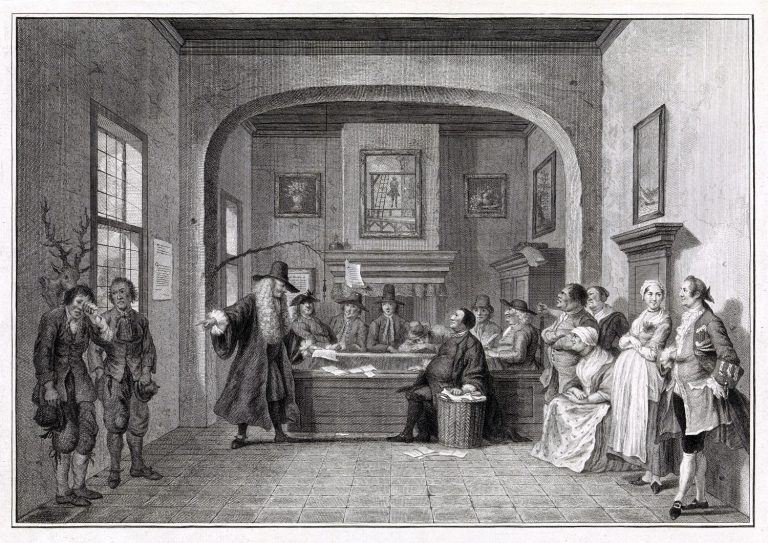
The autopsy was a recurrent source of conflict. One example in 1699 involved deputy sheriff Van der Dussen, a local police officer of the council with which the Court had previously had trouble in a similar case as he had taken the corpse of a man who had been stabbed to death on the Voorhout, although someone had already walked to the Court to report it, the Court decided again to imprison Van der Dussen at the Voorpoort and to summon his superior, the bailiff of The Hague. Subsequently, that official was also deprived of his freedom. The Court knew well from experience that speed was required in these types of cases, so they banished Van der Dussen from Holland for three years, before the council had time to call on the States for help. Unfortunately, the council managed to lodge a complaint with the States later that day, who then released the two prisoners and suspended the sentence until they had rendered their verdict. As only a provisional arrangement was reached, a similar case would occur later, in 1760. This was when the body of the former servant Elisabeth Spiering was removed from the canal on the Stille Veerkade and handed over to the council. The Court demanded to have the corpse, even though the council could easily demonstrate that it was entitled to the custody of the dead body. However, the Court was not convinced by this. It called several meetings with the local government in The Hague, during which both parties stood firm, and finally decided to take the corpse in their hands. It sent its police force to the place where the dead body was stored and broke down the door despite the protests of the deputy sheriff, then they kidnapped the corpse. Naturally, the council immediately complained to the States, which ordered the body to be returned. After much wrangling, the Court finally handed it back.
Original Dutch text
Een weerkerende bron van conflicten was de lijkschouw. In 1699, bijvoorbeeld, liet substituut-schout Van der Dussen -een politiefunctionaris van het ambachtsbestuur waar het Hof het in een vergelijkbaar geval al eerder mee aan de stok had gehad- het lijk van een op het Voorhout was doodgestoken en hoewel er al iemand naar het Hof was gelopen, om dat te vertellen. Het Hof besloot Van der Dussen opnieuw op de Voorpoort op te sluiten, en diens chef, de Haagse baljuw, te ontbieden. Ook die dienaar van justitie werd vervolgens van zijn vrijheid beroofd. Het Hof, dat van de vorige keer geleerd had dat in dit soort zaken snelheid was geboden, verbande Van der Dussen voor drie jaar uit Holland, vóór het ambachtsbestuur tijd had gehad om de Staten te hulp te roepen. Helaas, het ambacht had het toch klaar gespeeld om binnen één dag zijn beklag bij de Staten te doen, die de twee gevangenen vervolgens vrijlieten en het vonnis opschortten totdat ze uitspraak hadden gedaan. Omdat er daarna slechts een voorlopige regeling werd getroffen, kon zich in 1760 een soortgelijk geval voordoen. Toen werd het lijk van de voormalige dienstbode Elisabeth Spiering uit de gracht op de Stille Veerkade gehaald, en in handen van het ambachtsbestuur gesteld. Het Hof eiste het op, hoewel het ambachtsbestuur eenvoudig aan kon tonen recht te hebben op de schouw van het dode lichaam. Daardoor liet het Hof zich echter niet overtuigen. Het belegde een aantal vergaderingen met Den Haags lokale bestuur, waarbij beide partijen voet bij stuk hielden, en besloot zich tenslotte dan maar kwaadschiks van het lijk meester te maken. Het stuurde zijn politiekorpsje naar de plek waar het dode lichaam werd bewaard, liet ondanks de pro- testen van de substituut-schout de deur openbreken, en liet het lijk ontvoeren. Natuurlijk klaagde het ambachts- bestuur meteen bij de Staten, die opdracht gaven het lichaam te restitueren. Na uitvoerige chicanes deed het Hof dat uiteindelijk ook.
After inserting this article, I found a more detailed version of this story. Please find it here below.
I also found a document about a substituut-schout van der Dussen in The Hague, at the same time. His first name was Jacobus, his mother waf Neeltje van Opheer. Still no connection with our genealogy. To see the document, click here.